Five Inputs That Make AI Job Costing Actually Work

I've been watching restoration contractors try to estimate jobs for years, and there's a pattern I keep seeing. They think in terms of the finished product. Install baseboards. Replace drywall. Restore water damage. The mental image is the end result, not the sequence of work required to get there.
That compression creates a problem.
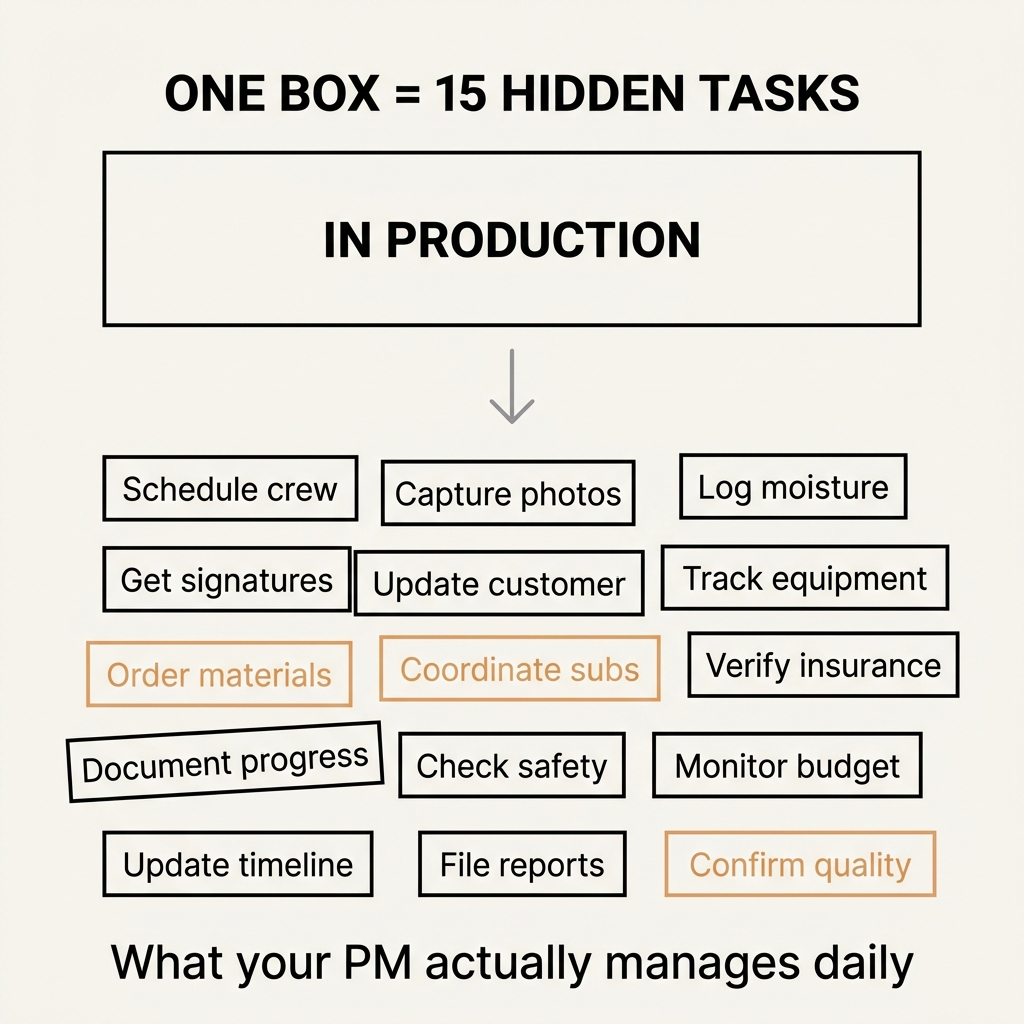
When contractors estimate based on what they visualize, they're systematically leaving out the steps that happen before the visible work begins. The removal. The prep. The scoring of paint lines before pulling baseboards so the wall doesn't get damaged. These aren't just minor details. They're the micro-tasks that quietly absorb costs and erode the thin margins most restoration companies are operating on.
The restoration industry averages 10-15% net profit margins, and more than one-third of companies are breaking even or losing money. That means out of every $100 you bill, about half covers wages and benefits, another third covers overhead, and the rest is actual profit. When you're absorbing costs that never made it into the scope, there's not much room left.
AI job costing addresses this by doing something contractors can't easily do manually. It tracks actual time spent across all those micro-tasks that get mentally compressed into one action. But AI isn't magic. It's structured intelligence that reveals what was always there but invisible. And it only works when you understand what data it needs and why each input matters.
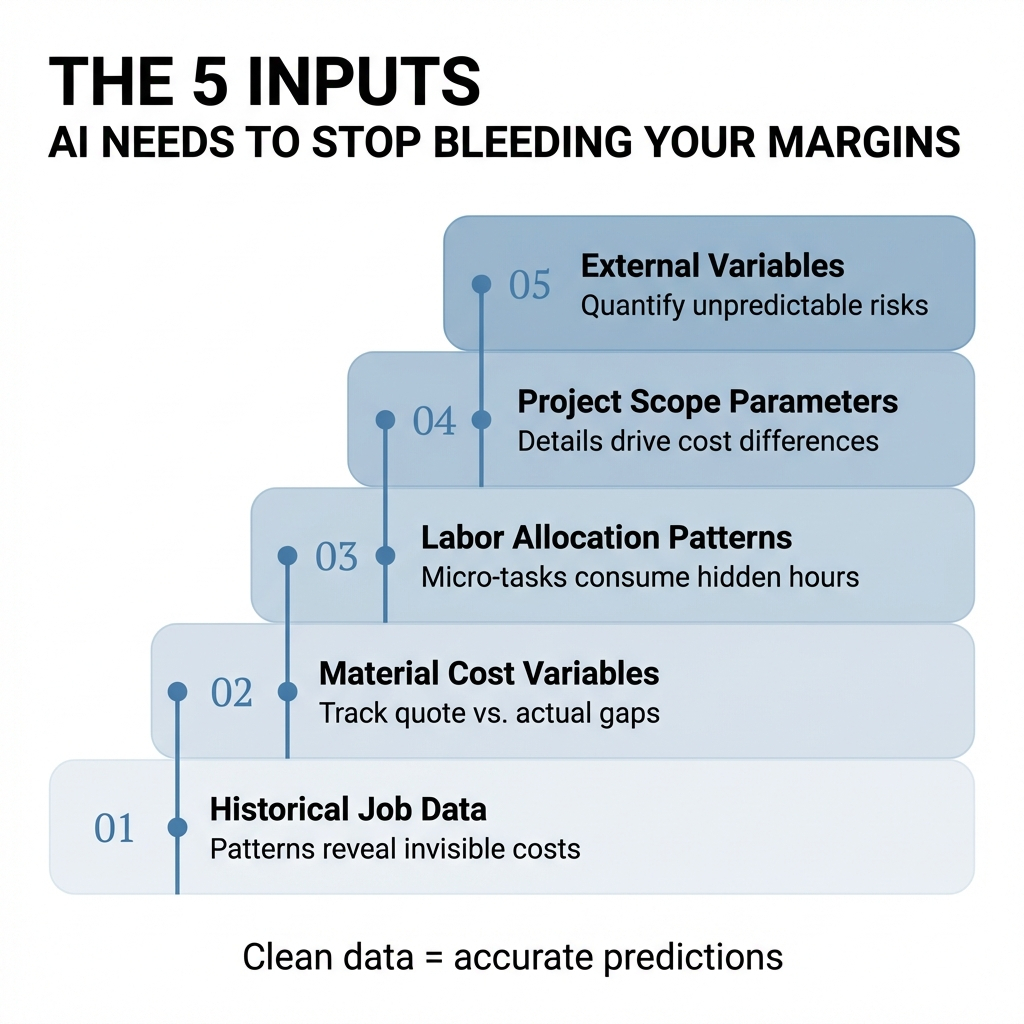
This tutorial walks through the five critical inputs that make AI job costing functional, not theoretical. Each one acts as a diagnostic checkpoint where you can audit your own data quality and identify where your current methods leave money invisible.
Input One: Historical Job Data
AI learns from patterns, which means it needs completed job data to establish what "normal" looks like for your operation. Three months of historical records reveals more than three years of intuition because the data shows what actually happened, not what you remember happening.
When you feed AI historical job data, it's analyzing actual crew time against estimated time. If one baseboard replacement job took 4 hours and another took 6 hours, and that 6-hour job also generated an unplanned paint touch-up line item, the AI starts recognizing the pattern. It doesn't "know" about scoring paint before removal. It sees that jobs without certain prep steps consistently generate additional costs downstream.
The system identifies that contractors who build in those micro-tasks upfront have more predictable costs and fewer change orders. So when estimating a new baseboard job, it factors in the time buffer that reflects doing it right the first time, based on what the data showed actually happened on jobs that didn't have rework costs.
This is the feedback loop in action.
But here's where most contractors hit their first obstacle. When AI recommends a time buffer that's higher than what they'd normally quote, the instinct is to assume the AI is overestimating. The data might be right, but if your team isn't clocking in and out properly, the AI is learning from flawed patterns.
The quality of your historical data determines the accuracy of your future estimates. If your crew forgets to clock out, rounds their hours, or uses buddy punching, you're teaching the AI to replicate those errors at scale.
Input Two: Material Cost Variables
Material costs seem straightforward until you track the gap between what you quoted and what you actually paid. This is where hidden margin erosion happens, and most contractors don't realize it until they review completed job financials months later.
AI tracks material cost variables in real time by connecting your estimates to your actual purchase orders and invoices. When you quote a job based on $X per sheet of drywall, but your supplier increases prices or you need a specialty product mid-job, that variance gets captured immediately.
The system learns which materials tend to have volatile pricing, which suppliers are more consistent, and which job types generate unexpected material additions. Over time, it builds cost buffers into estimates for materials that historically deviate from quoted prices.
This matters because rework alone eats up 12-20% of project costs on average. For a $10 million contractor, that's $1.2 million in lost margin. When you're operating on 10-15% net profit margins, a few percentage points of material variance can eliminate your entire profit on a job.
The AI doesn't just flag the variance. It teaches you which material assumptions in your estimates are systematically wrong. Maybe you're consistently underestimating disposal costs. Maybe your drywall estimates don't account for waste from cuts and damaged sheets. These patterns become visible when the system compares quoted materials to actual materials across dozens of completed jobs.
Input Three: Labor Allocation Patterns
Labor represents 50-60% of total project costs in construction, which makes it both the biggest expense and the hardest to estimate accurately. The challenge isn't just tracking hours. It's tracking what those hours were actually spent doing.
Contractors allocate labor based on installation time because that's the visible work. But the crew is spending time on demolition, disposal, surface prep, and then installation. The labor allocation in your head doesn't match what's happening on the jobsite, and that gap compounds across every job you run.
AI surfaces this by tracking actual time spent across all those micro-tasks that get mentally compressed into one action. When you estimate 4 hours for baseboard replacement, but the crew logs 2 hours for removal, 1 hour for paint touch-up from improper removal technique, 30 minutes for disposal, 45 minutes for surface prep, and 2 hours for installation, you're looking at 6.25 hours of actual labor.
That's not a small variance. On a $2 million project, a 5% underestimate represents $100,000 in variance before the first crew member arrives on site.
The system learns which tasks consistently take longer than estimated and adjusts future job costing accordingly. But this only works if your time tracking data is clean. If your crew is rounding every job to exactly 4 hours or 8 hours, the AI can't distinguish between actual work patterns and estimation at the end of the day.
Real-time time tracking matters because it captures the granularity that makes AI useful. When labor time shows 12 hours of drywall installation but only 4 sheets of drywall purchased, something's off. Either they're logging time to the wrong job code, or they're clocking in but not working on that specific task. These inconsistencies don't break the system immediately, but they slowly erode the AI's ability to accurately predict costs.
Input Four: Project Scope Parameters
Two baseboard replacement jobs might look identical on paper, but one takes 4 hours and the other takes 6 hours. AI distinguishes between similar jobs that cost completely differently by analyzing the scope parameters that contractors often overlook.
Room size matters. Baseboard material matters. Whether the home is occupied during the work matters. Whether there's furniture that needs to be moved matters. Whether the existing baseboards are nailed or glued matters. These variables don't always make it into the initial scope description, but they significantly impact actual costs.
The system builds a profile for each job type based on these parameters. When you input a new estimate, it compares the scope parameters to historical jobs with similar characteristics and flags potential cost differences. If you're quoting a baseboard job in an occupied home with furniture, and your historical data shows those jobs consistently take 30% longer than vacant homes, the AI adjusts the estimate accordingly.
This is where AI moves from automation to intelligence. It's not just replicating your past estimates. It's identifying which variables in the scope actually drive costs and teaching you to account for them upfront.
The challenge is that contractors often don't capture these scope parameters consistently. If your job descriptions are vague or inconsistent, the AI can't learn which variables matter. You need structured data entry that captures the details that seem minor but systematically impact costs.
Input Five: External Variables
Permit delays happen. Weather disrupts schedules. Supply chains create material shortages. These external variables aren't controllable, but they're predictable patterns that AI can factor into job costing.
When you track how often permits delay start dates, the system learns to build buffer time into projects that require permits. When you track weather-related delays by season and region, it adjusts labor estimates for outdoor work during high-risk periods. When you track supply chain issues by material type and supplier, it flags potential delays before you commit to a timeline.
This doesn't eliminate the unpredictability. It quantifies the risk so you can price it appropriately. If jobs requiring city permits have a 40% chance of a two-week delay, and that delay costs you $X in extended overhead, the AI factors that expected cost into the estimate.
The system learns from your corrections. When a permit delay happens that wasn't anticipated, you flag it in the system. When a supplier delivers on time despite historical delays, you note it. Over time, the AI refines its understanding of which external variables are truly unpredictable versus which ones follow patterns you can account for.
External variables become less external when you have enough data to see the patterns. The weather isn't controllable, but the impact of weather on your specific operation in your specific region becomes measurable and predictable.
What Happens When You Feed AI Partial Data
Garbage in, garbage out still applies. If your time tracking is inconsistent, your material costs aren't connected to actual invoices, your scope parameters are vague, and your external variables aren't logged, the AI is learning from noise instead of signal.
The most obvious red flag is the 65-hour shift with no breaks. That shows up in shift reports immediately. But the subtle data quality issues are harder to catch. Consistent rounding where every job is exactly 4 hours or 8 hours, never 4.3 or 7.6. Gaps where there's no time logged between 11am and 1pm across multiple days, but job notes show work was continuous. Labor time that doesn't correlate with material usage.
These small inconsistencies don't break the system immediately, but they slowly corrupt job costing accuracy. The AI is learning from flawed patterns, which means its recommendations will systematically replicate those flaws.
You can audit your data quality before the AI even starts making recommendations. Look at your time logs. Are crews clocking in and out in real time, or are they estimating at the end of the day? Look at your material costs. Do your invoices match your purchase orders, or are there consistent variances? Look at your scope descriptions. Can you distinguish between similar jobs based on the parameters you've captured?
If the answer is no, you're not ready for AI job costing. You need to fix your data collection process first.
The Feedback Loop
AI achieves 97% accuracy in construction cost prediction when it has clean data and continuous feedback. The system becomes smarter with each completed job because it's learning from reality, not theory.
When you complete a job, you compare the AI's estimate to actual costs. If the estimate was accurate, the system reinforces that pattern. If the estimate was off, you investigate why. Was it a data quality issue? Was it an external variable that wasn't captured? Was it a scope parameter that the AI hadn't learned to account for yet?
You correct the input, and the AI adjusts its model. The next time it estimates a similar job, it factors in what it learned from your correction. This is how the system moves from generic estimates to operation-specific intelligence.
The feedback loop only works if you're actually reviewing completed jobs and feeding corrections back into the system. If you're treating AI as a set-it-and-forget-it tool, you're missing the entire point. The intelligence comes from the iteration, not the initial setup.
Machine learning algorithms continuously improve accuracy over time through iterative feedback. When AI initially underestimates costs on specific work, it automatically adjusts for future similar projects. The system doesn't just automate. It teaches your business what it doesn't know about itself.
Where Contractors Discover Their Biggest Cost Blind Spots
After implementing structured AI costing, contractors typically discover three consistent blind spots. First, they're systematically underestimating prep work. The removal, the surface prep, the protection of surrounding areas. These tasks get mentally compressed into the installation work, but they're consuming 20-30% of actual labor time.
Second, they're not accounting for the cascading costs of skipped steps. When you don't score the paint before removing baseboards, you create a paint touch-up task that wasn't in the original scope. When you don't properly protect floors during demolition, you create a cleaning or repair task. These downstream costs are predictable when you analyze historical data, but they're invisible when you're estimating based on the finished product.
Third, they're absorbing costs that should be in the scope. Simple things like baseboard removal, disposal fees, permit costs, site protection. These line items consistently get left out of estimates, which means the contractor is taking on costs that should be reflected in the price.
The restoration industry's average overhead is 38% of gross revenue while average net profit before taxes is only 3.8%. When you're operating in that environment, these invisible costs aren't minor inefficiencies. They're the difference between profitability and breaking even.
AI doesn't create new costs. It makes existing costs visible so you can price them appropriately. The contractors who adopt this approach early aren't just improving their estimates. They're building competitive advantage through better information.
What data quality issue in your current operation would you need to fix before AI job costing could work for you?