The AI Stack Restoration Contractors Are Actually Building

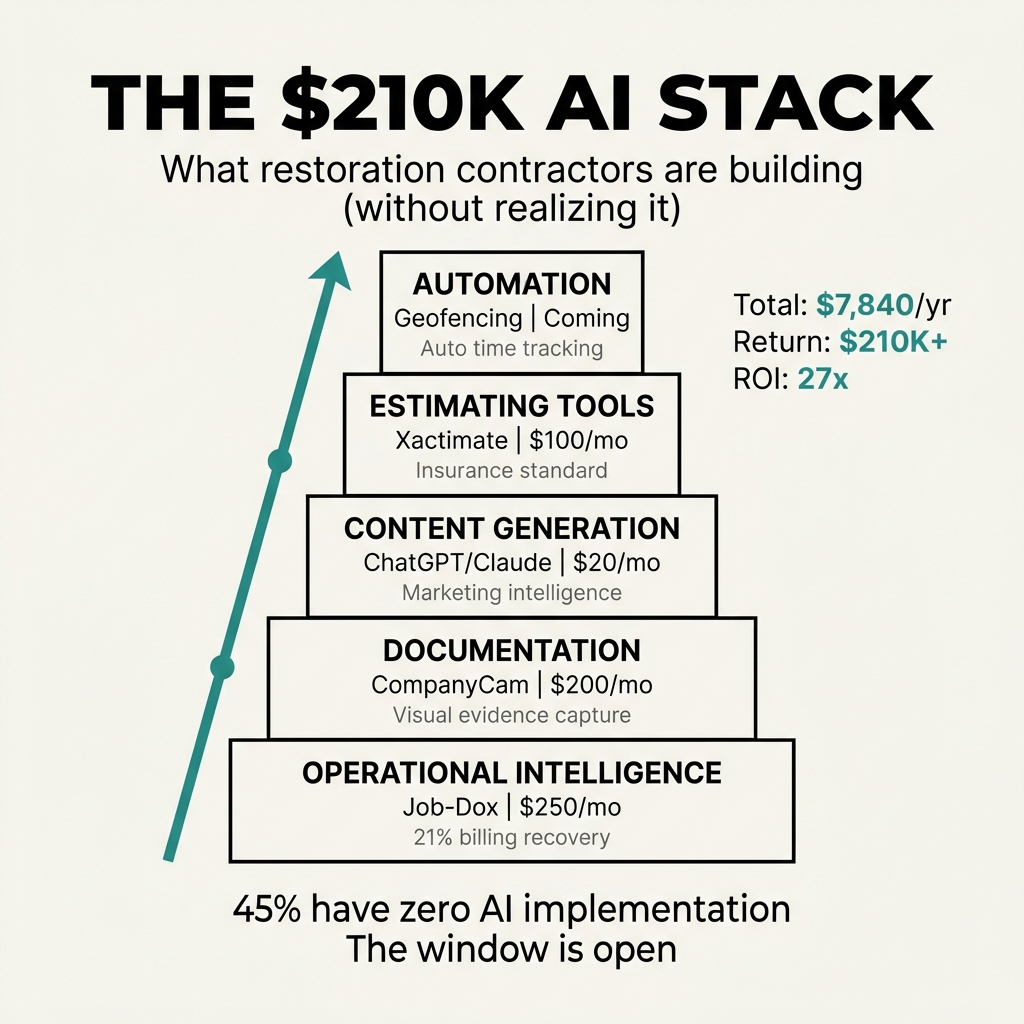
I've been inside restoration operations since 2013, and I'm watching a pattern emerge that most contractors don't realize they're part of. They're not just adopting AI tools. They're building intelligence infrastructure, layer by layer, often without recognizing the architecture taking shape.
This isn't about which tool is "best." It's about understanding what each layer does, what it costs, and how they stack together to create operational leverage that small teams couldn't access before.
The restoration industry sits at an interesting inflection point. 45% of construction organizations report zero AI implementation, while 87% believe AI will meaningfully transform their business. That gap between belief and action creates a competitive window for contractors who move decisively.
The Foundation Layer: Operational Intelligence
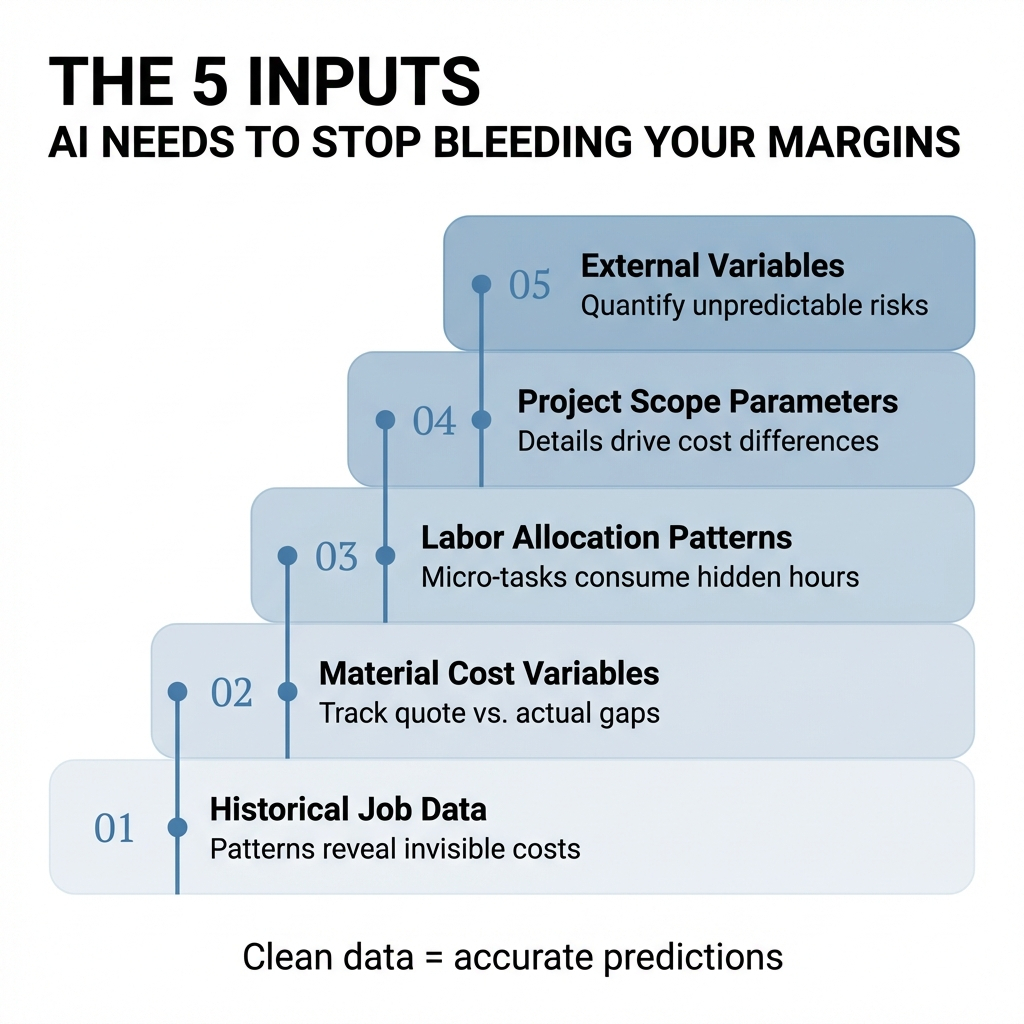
When contractors start building their AI stack, they typically begin with operational intelligence. Not marketing tools. Not fancy automation. They start with visibility into what's actually happening in their business.
Job-Dox sits at this foundation layer. It's designed to learn how your company works and help you operate it. The system generates tasks based on your processes and assigns them to appropriate staff members based on their role in the company and on each project.
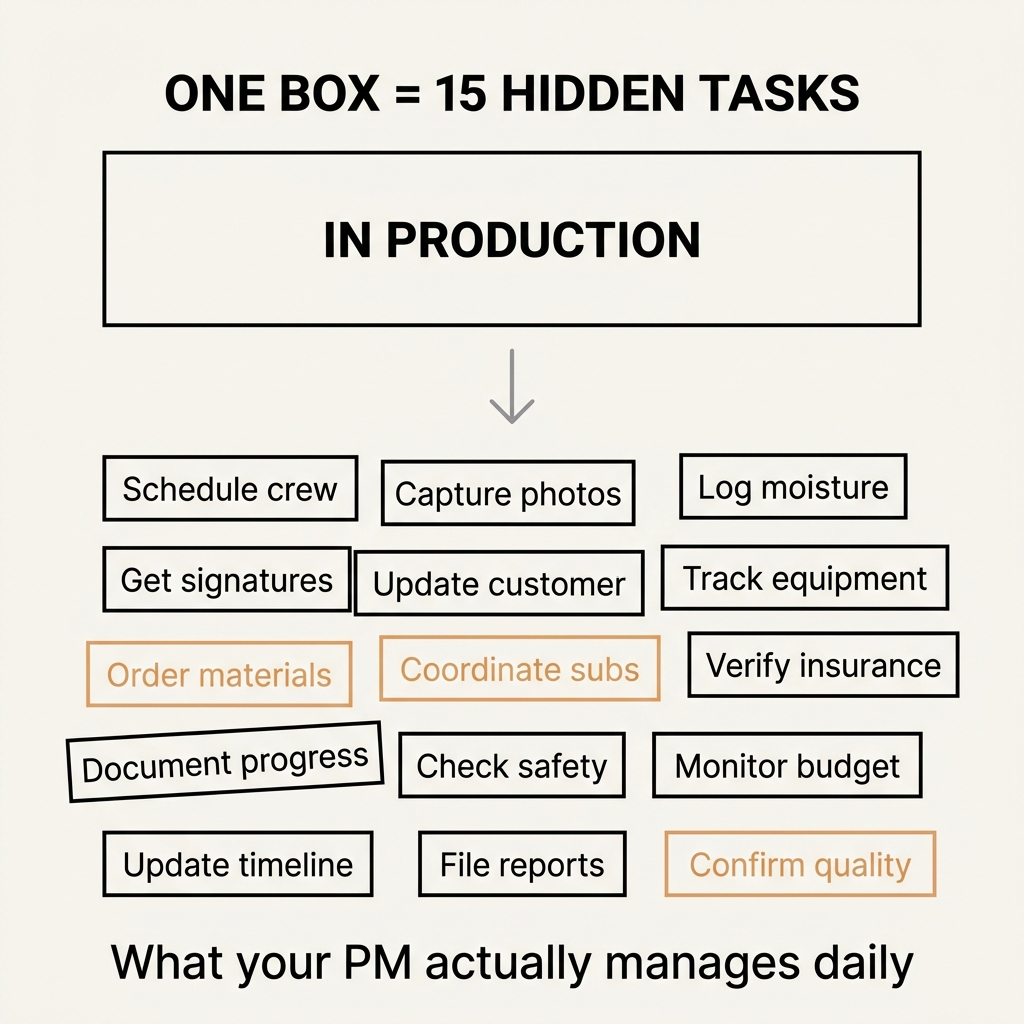
The invisible problem this solves: Contractors often have a big picture idea of their company while forgetting the nuances along the way. The field team completes work that never makes it onto invoices. Office staff waits for scope data from the field. Labor hours get forgotten. Change orders happen verbally but never get formally billed.
These aren't dramatic failures. They're operational leakage. Around 15% of chargeable work is never billed to clients in service-based businesses. For a $2M restoration contractor, that's $20K-$100K annually just disappearing into the gap between field operations and office billing.
The economics: Job-Dox runs $50 per user per month with a 5-user minimum ($250/month) plus a one-time $1,000 white glove onboarding fee. That onboarding includes direct training for all staff members, continuously, for as long as you maintain an active subscription.
The measurable impact: Users save 15 minutes per employee per day, primarily through reduced communication friction. When your field team knows exactly what tasks they need to complete because the system generated them based on your process, you eliminate the constant "hey did you remember to..." conversations. At $25 per hour average employee cost with 5 employees, that's $6,562.50 annually in time savings alone.
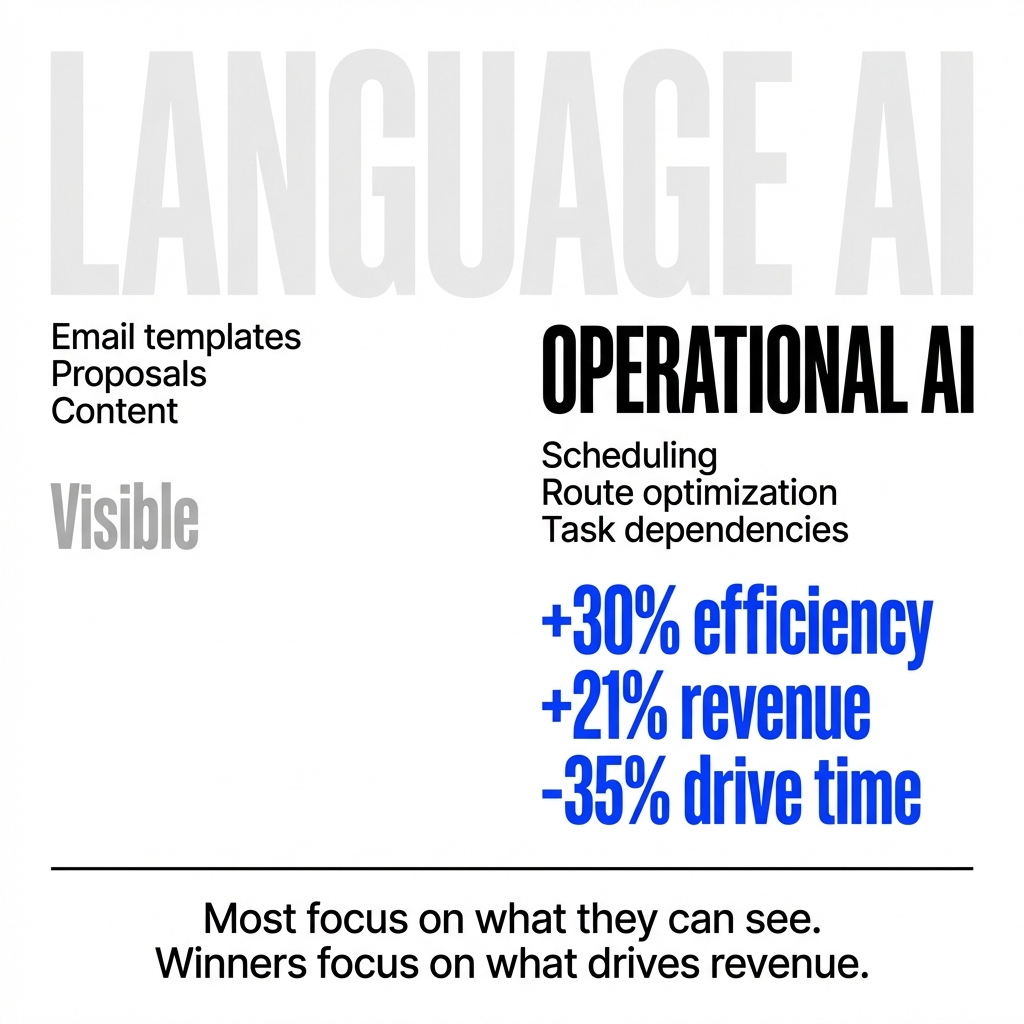
The bigger number is billing recovery. Users see 21% improvements in revenue. The money was always there in the work you did. It just wasn't making it onto the invoice.
The Documentation Layer: Visual Evidence
Once contractors have operational intelligence in place, they typically add documentation capabilities. This layer captures what's happening in the field and creates a visual record that protects the business and speeds up claims processing.
Tools like CompanyCam and Encircle sit here. Encircle is particularly useful in water damage restoration, using AI to help make work faster and more accurate. Technicians can take photos, videos, and moisture maps, with AI reducing mistakes and creating detailed reports.
The integration pattern matters. Job-Dox and CompanyCam work together through a two-way integration. After initial setup (about 15 minutes using an API key), if you create a project in one platform, it automatically creates the project in the other. Photo documentation pushes back and forth, so you always have it in both files. This makes it possible to generate full project reports with all documentation in one place.
The reality check: Job-Dox has media features similar to CompanyCam. You don't necessarily need both to function. The question is whether the specialized documentation features justify the additional monthly cost for your specific operation.
CompanyCam typically runs around $30-50 per user per month depending on plan level. For a 5-person team already running Job-Dox, you're looking at $400-550 monthly for the combined operational intelligence and documentation stack.
The Content Layer: Marketing Intelligence
This is where contractors make an interesting leap. After establishing operational intelligence and documentation, many add AI tools for content generation. Tools like ChatGPT or Claude help contractors generate content for email lists and social pages.
The monthly cost here is relatively low. ChatGPT Plus runs $20/month. Claude Pro is similar. You could add this layer for less than the cost of one additional user license on most operational tools.
The pattern I'm noticing is that contractors who successfully adopt this layer already have their operations stabilized. They're not using AI to fix chaos. They're using it to communicate about operations that are already working.
The Estimating Layer: Industry-Specific Tools
For certain types of restoration work, industry-specific estimating tools like Xactimate and Symbility exist to generate scopes. These tools aren't AI-powered in the way operational intelligence platforms are. They're database-driven pricing systems that insurance companies recognize and accept.
Job-Dox houses estimating tools for companies with the freedom to have their own pricelists. But for insurance work, Xactimate remains the standard. According to ATI Restoration, the industry has seen a substantial shift from inefficient on-location estimating to massively scalable solutions, with 5x and even near 10x improvement in capacity for specialized positions.
Xactimate pricing varies by subscription level, typically running $75-150 per month per user. This layer adds significant cost to the stack, but for contractors doing insurance restoration work, it's not optional.
The Emerging Layer: Geofencing and Automation
The next layer starting to appear in contractor AI stacks is geofencing and automatic time tracking. Job-Dox is currently developing AI timesheets that will geofence staff location. If they're close to a listed project in the system, it will automatically clock them in, and then out again once they've left for a long enough period.
This addresses the current manual clock-in process. Staff currently clock in manually to different tasks and trades, and those hours get applied to appropriate categories in the budget tool. Removing that manual step eliminates another friction point in data capture.
This layer isn't widely available yet, but it represents the direction the stack is moving. Less manual input. More automatic capture of what's actually happening.
The Real Cost of the Complete Stack
Here's what a functional AI stack actually costs for a 5-person restoration contractor:
Foundation Layer (Operational Intelligence)
Job-Dox: $250/month + $1,000 one-time onboarding
Annual first-year cost: $4,000
Documentation Layer
CompanyCam: ~$200/month (optional if using Job-Dox media features)
Annual cost: $2,400
Content Layer
ChatGPT Plus or Claude Pro: $20/month
Annual cost: $240
Estimating Layer (if doing insurance work)
Xactimate: ~$100/month per user (typically 1-2 users need access)
Annual cost: $1,200-2,400
Total annual cost range: $7,840-$9,040 for the complete stack.
Against that cost, you're looking at measurable returns. The 15-minute daily time savings per employee generates $6,562.50 annually in recovered labor cost. The 21% billing recovery on a $1M contractor is $210,000 in captured revenue that was previously slipping through.
The math isn't complicated. The stack pays for itself in the first month if you're actually capturing the billing leakage.
The Adoption Pattern That Actually Works
The sequence matters more than most contractors realize. Starting with marketing AI before you have operational intelligence is building in the wrong order. You're creating content about a business you can't see clearly yet.
The pattern that works starts with visibility. Operational intelligence first. Documentation second. Content third. Estimating tools get added based on the type of work you're doing, not based on a universal adoption sequence.
But here's what determines success more than the tools themselves: team adoption.
Tools are only as powerful as we allow them to be. If you aren't a strong enough leader to get buy-in from your teams, it doesn't matter what tools you try. None of them will work.
The most common point of resistance comes from senior employees who think they know better than the boss. The "we do it better this way" person who thinks because they get their things done effectively in their mind, it can't be improved upon.
What breaks through that resistance isn't the technology. It's the outcome. For restoration companies in particular, it's actually getting to go home on time. Spending more time with their families because the system is making their lives easier.
You didn't get that before.
The Integration Reality in 2025
The promise of seamless integration is everywhere in software marketing. The reality is more nuanced.
Some integrations genuinely work. Job-Dox and CompanyCam is one example. After a 15-minute API key setup, projects sync automatically in both directions. Photo documentation flows back and forth without manual intervention.
Other integrations still require manual handoffs. According to industry analysis, 2024 marked the year the restoration industry started achieving integration, but it's not a panacea where data is entered once. It's steps taken with platforms opening technology and allowing information to be shared.
The question to ask isn't "does it integrate?" The question is "what does integration actually require from my team on a daily basis?"
If integration means someone still has to manually move data between systems, you haven't eliminated friction. You've just moved it to a different part of the process.
What Separates Successful Adopters
After watching contractors implement AI tools for years, a clear pattern emerges between those still using tools six months later and those who abandon them in the first 90 days.
It's not about technical sophistication. It's not about company size. It's about leadership and process clarity.
Contractors who succeed with AI tools already have some level of process definition. They might not have it documented perfectly, but they know how they want their company to run. The AI tool helps them enforce that process consistently.
Contractors who struggle are often trying to use AI tools to create process where none exists. The tool can't define your process for you. It can only help you execute the process you already know you want.
The second factor is direct training. When the software company trains your staff directly rather than training you to train your staff, adoption rates improve significantly. You're not asking the contractor to become the translator between the tool and the team. The tool provider takes that responsibility.
The third factor is measurable outcomes in the first 30 days. When field staff can see that they're actually getting home earlier, resistance drops. When office staff can see that invoicing is faster and more complete, adoption accelerates.
The technology enables the outcome, but the outcome drives the adoption.
The Competitive Window
The restoration industry sits at an unusual moment. 85% of contractors believe AI will reduce time spent on repetitive tasks, and 75% anticipate AI will improve learning from past projects through better use of historical data.
But 45% of organizations report zero AI implementation.
That gap creates opportunity. The contractors who build functional AI stacks now, while the majority of the industry is still planning, gain operational leverage that compounds over time.
This isn't about being an early adopter for the sake of being first. It's about recognizing that competitive advantage in 2025 isn't better labor. It's better information.
The AI stack doesn't replace your team. It gives your team the intelligence infrastructure to operate like companies ten times their size.
The question isn't whether to build this stack. The question is whether you build it while there's still a competitive window, or whether you build it after it becomes table stakes and the advantage disappears.
What's stopping you from starting with the foundation layer?