Why Contractors Are Investing in the Wrong AI

When contractors reach out to me about AI, they want to talk about ChatGPT. They've been using it to build email templates, draft proposals, maybe generate some content for their website. They're excited about it. They consider this "adopting AI."
I understand the appeal. ChatGPT is accessible, visible, and feels safe to experiment with. You can generate content, review it, and choose whether to use it. There's no commitment. No risk.
But here's what I'm noticing across the field service industry.
The Invisible Problem
While contractors spend time perfecting email templates with language AI, they're not addressing the operational problems that actually consume their margins. They don't realize that AI scheduling exists for dispatch teams. They haven't discovered tools that assess project status daily and automatically generate the next tasks their staff needs to complete. They're missing the systems that prevent revenue from falling through the cracks.
The distinction matters because there are really two categories of AI, and most contractors are focused on the wrong one.
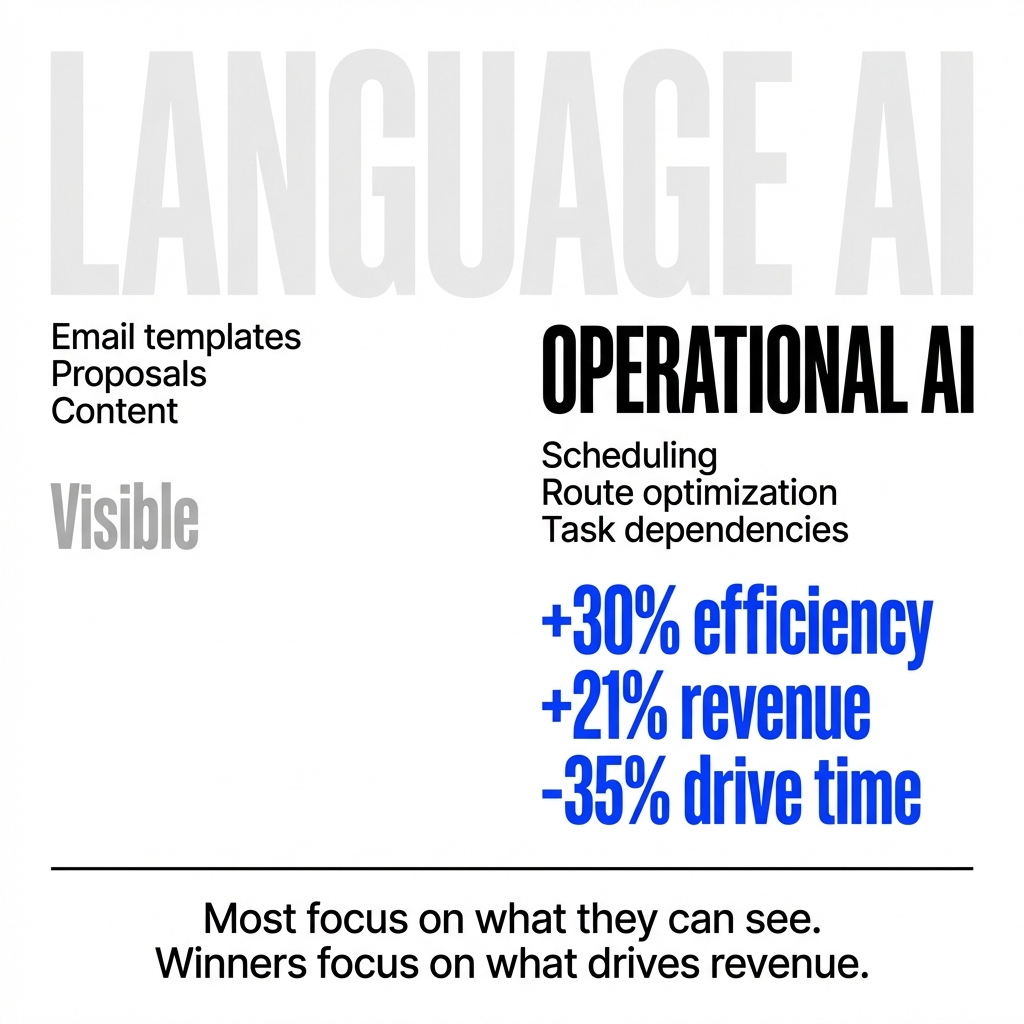
Language AI handles communication tasks. It writes emails, generates proposals, creates content, responds to messages. It's what you see in ChatGPT and similar tools.
Operational AI solves optimization problems. It handles scheduling, route planning, task dependencies, resource allocation, and predictive analytics. It addresses the mathematical challenges inherent to running a field service business.
The data tells a clear story about which category delivers greater value. McKinsey reports that adopting AI in field service operations can boost technician productivity and overall efficiency by up to 30%. That's not from better emails. That's from better operations.
The Real Cost of Manual Operations
Our studies show that not using operational AI tools costs a business owner roughly 15 minutes per day, per employee. If you have four employees, you're losing an hour every day just managing things that could be automated.
What happens during those 15 minutes? Contractors are manually solving optimization problems every morning. Assessing routes. Determining drive time. Putting the right crew in the right spot. These are mathematical problems that operational AI was designed to solve.
Research on route optimization shows organizations typically see gains of 25-35% less drive time after integrating AI. That's not marginal improvement. That's recovered capacity that translates directly to additional jobs, reduced fuel costs, and better customer service.
The compounding effect becomes clear when you calculate annual impact. Fifteen minutes per employee per day equals 65 hours per year per person. For a crew of ten, that's 650 hours annually spent on manual coordination that intelligent systems could handle automatically.
Why Contractors Choose the Familiar
I've noticed a pattern in how contractors respond when I show them they're losing an hour daily on routing decisions while spending time on email templates. There's always some resistance.
People who work in trades trust tried and true methods. Change is hard for everyone, but it's especially difficult for business owners with mouths to feed at home and at work. They're hesitant to change things they know work, even if those changes could improve their quality of life.
But here's what's interesting. These same contractors are willing to experiment with ChatGPT, which is also new technology. The difference comes down to perceived risk.
ChatGPT can generate content, but you can choose not to use it if you don't like it. When you implement operational AI into your business ecosystem, choosing not to use it can make things harder than if you hadn't implemented it at all. Language AI feels like a suggestion you can ignore. Operational AI becomes part of the system.
This perception gap explains why 43% of U.S. workers use ChatGPT at work. The familiarity creates comfort. Everyone has used a chatbot or autocomplete. The technology mirrors existing consumer experiences.
Operational AI requires a different mental model. You're not generating content to review. You're integrating intelligence into your workflow that makes decisions based on data you might not even realize you're collecting.
The Dependencies You're Missing
Let me give you a specific example of what operational AI catches that contractors typically miss.
Billing often needs to happen within a certain timeframe. You likely have an administrator responsible for sending invoices to insurance carriers. But that administrator isn't in the field. She doesn't know what happened on the job site.
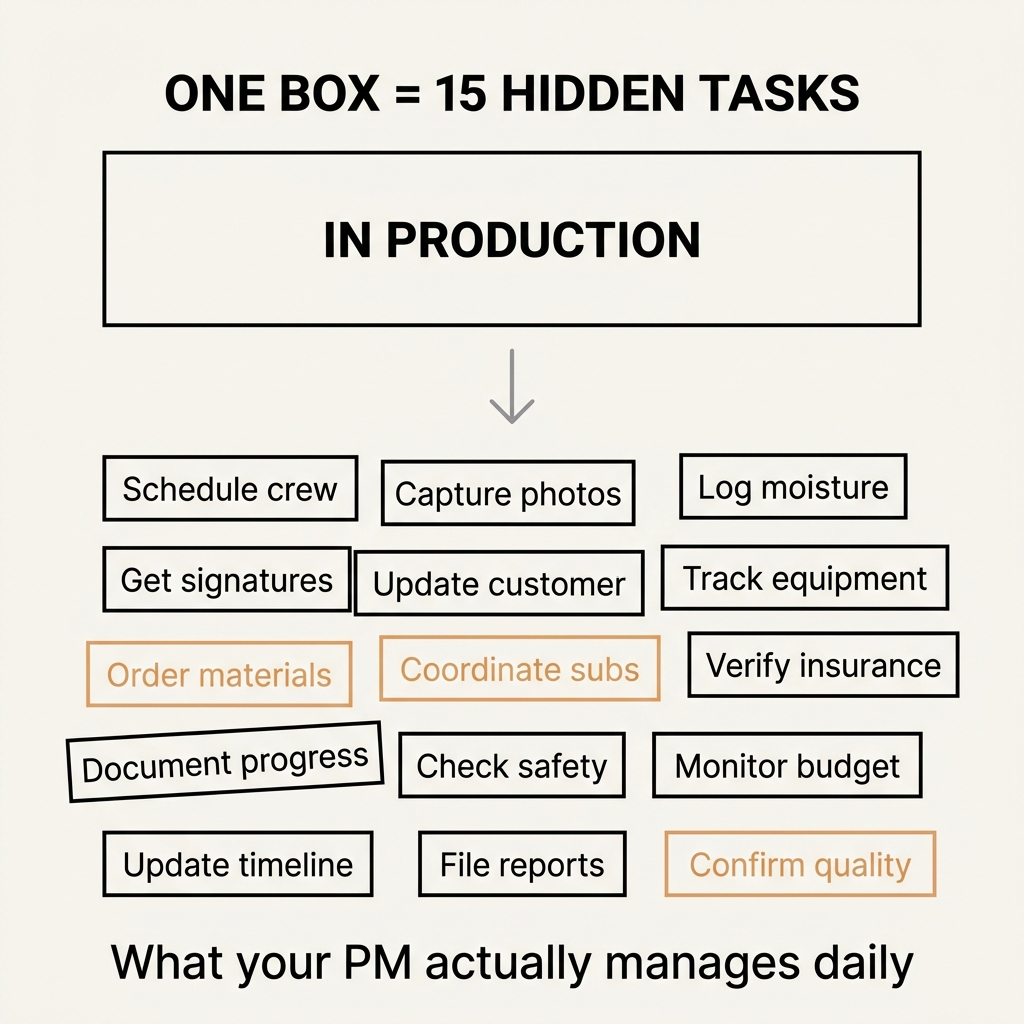
Without intelligent task generation, the workflow breaks down. The task gets listed as "Send Scope to Carrier," but the administrator can't complete it because she doesn't have the necessary information. The project manager hasn't gathered the scope data. The invoice gets delayed.
Operational AI recognizes these dependencies. The system knows it needs to generate a task for the project manager first: "Gather scope data and add it to the scope sheet." Only after that task is completed does it generate the invoice task for the administrator.
These invisible dependencies are where revenue disappears. We built Job-Dox because our restoration company, Mr Restore, was regularly losing revenue from things falling between the cracks. One year we lost nearly $250,000 because we simply forgot to gather the right information to bill for completed work.
The work was done. The customer was satisfied. But we couldn't collect payment because the operational process had gaps that nobody was tracking.
Our studies now show that contractors can increase their collected revenue by roughly 21% by using operational intelligence tools. Research on revenue leakage confirms that organizations lose 1-9% of total revenue to preventable leakage, with contract mismanagement alone accounting for 60% of all leakage.
The Honest Assessment Problem
When I share that 21% revenue recovery number with contractors, most want to believe they aren't making the same mistakes. Maybe they aren't. But they could be making other similar mistakes they don't realize exist.
Being honest with yourself as a business owner is the most helpful thing you can do to build a strong business. Identify your weaknesses, whether in personality or in operation, and find the tools and people to fill those gaps.
The challenge is that operational inefficiencies are invisible until you measure them. You can't see the revenue you're not collecting. You can't feel the time you're wasting on manual routing. You can't observe the task dependencies that are breaking your billing cycle.
Language AI is visible. You see the email it writes. You review the proposal it generates. The output is tangible and immediate.
Operational AI works in the background. It optimizes schedules you would have created anyway. It identifies dependencies you didn't know existed. It prevents problems you never saw coming.
The Competitive Window
Most contractors right now are in the ChatGPT experimentation phase. They're exploring language AI because that's what dominates the conversation. The technology is novel, accessible, and heavily marketed through consumer applications.
This creates an education gap. Contractors hear "AI" and think "ChatGPT" rather than recognizing that route optimization algorithms, predictive maintenance systems, and intelligent scheduling platforms represent more mature and immediately applicable AI technologies for their business model.
The contractors who understand this distinction are building an advantage while their competitors remain distracted. Right now, the gap is like crossing a busy street. It might be a little stressful, but it's manageable and doable.
But for those who wait, it could become a chasm in the next 24 months.
What changes in that window? A combination of factors. The operational data accumulated by early adopters compounds into better predictions and more refined optimization. The efficiency gains stack on top of each other. The AI itself continues to improve rapidly.
The contractors using operational AI today are positioning themselves in the utility phase of technology adoption while competitors remain in the novelty phase. Data suggests this matters. Currently, 48% of employers use field service management software, but this number is projected to reach 70% by 2027 as AI capabilities make these tools indispensable for competitiveness.
The businesses that adopt operational intelligence early don't just gain efficiency. They build institutional knowledge into their systems. They train their AI on their specific operations, customer patterns, and service requirements. They create advantages that become harder to replicate as time passes.
What This Means for Your Business
I'm not suggesting language AI has no value. Email templates and proposal generation can save time. Content creation tools can help with marketing. These applications serve a purpose.
But the ROI disparity is significant. A contractor who optimizes dispatch scheduling and reduces drive time by 15% generates exponentially greater returns than one who automates email responses. The math is straightforward.
Field service operations involve unique complexity that makes them particularly well-suited for operational AI. You're coordinating physical presence, managing equipment and materials, responding to unpredictable service demands, and optimizing geographical routing while maintaining quality standards and customer commitments.
These are optimization problems. They're mathematical challenges where operational AI demonstrates measurable impact on revenue per technician, customer retention, and competitive positioning.
The question isn't whether to adopt AI. The question is which AI to adopt first and where to focus your limited time and resources.
When you're evaluating AI investments, consider where the actual bottlenecks exist in your operation. Look at where revenue disappears. Measure where time gets consumed. Identify where operational complexity creates inefficiency.
The most valuable technological improvements often operate invisibly in the background. They optimize schedules, predict parts needs, route efficiently. They don't announce themselves. They just make your operation work better.
Language AI is visible and familiar. Operational AI is invisible and unfamiliar. But invisible doesn't mean less valuable. Often, it means the opposite.
The contractors who understand this principle will allocate their technology investments very differently than those chasing visible innovation for its own sake. They'll build advantages that compound over time rather than adopting tools that generate marginal improvements in areas that weren't bottlenecks to begin with.
What operational problems are you solving manually right now that AI could handle automatically?