Why I Started Writing About AI for Contractors (And What I'm Actually Trying to Do)

I'm not a journalist. I'm not an AI researcher. And I'm definitely not someone who's going to tell you that artificial intelligence is going to revolutionize your business while having never actually run one.
What I am is a restoration contractor and a software builder who got tired of watching our industry get talked at by people who don't understand it.
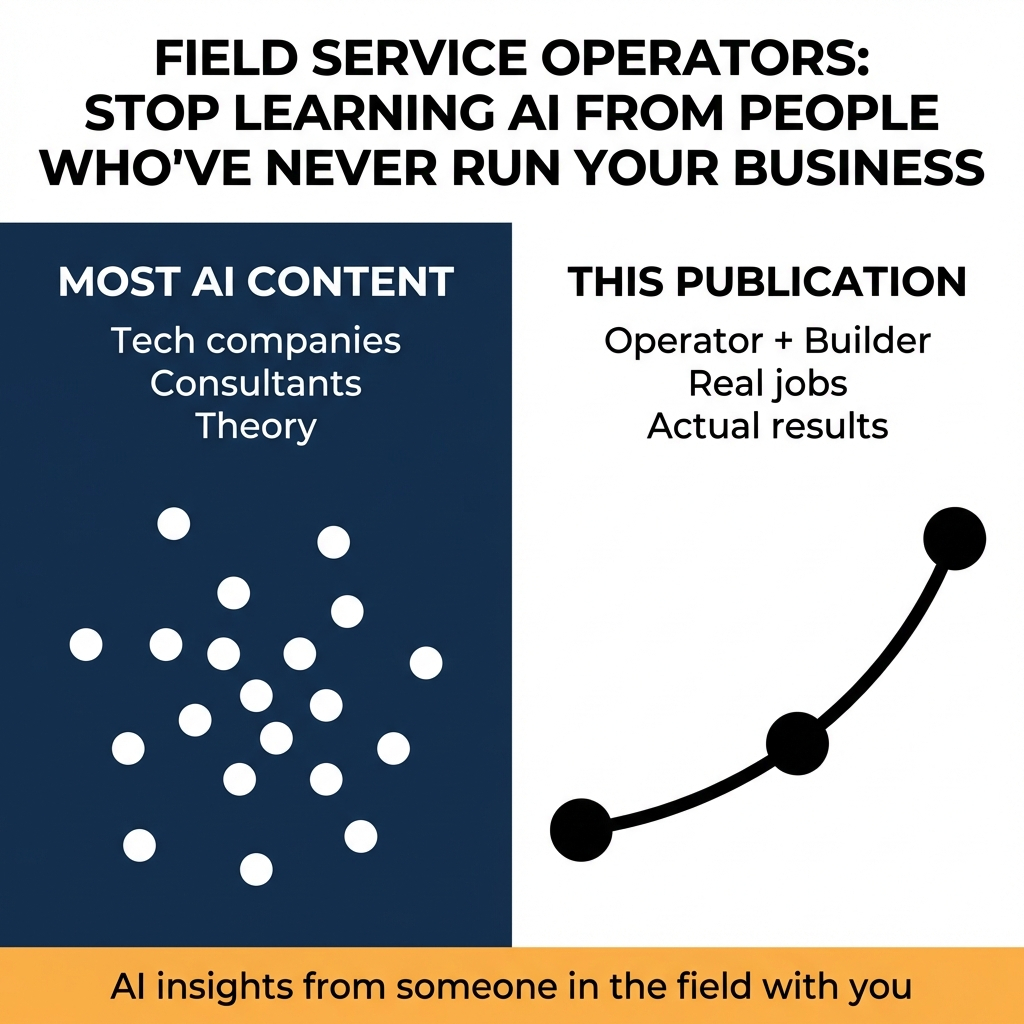
Here's the situation I kept running into. On one side, you've got the tech world pumping out AI content that's either way too theoretical to be useful or written for Fortune 500 companies with IT departments and six-figure software budgets. On the other side, you've got contractors who know something is shifting but can't find a straight answer about what any of it actually means for a field service business.
There's almost nothing in between.
That gap is why I'm writing this.
Who I Am and Why It Matters
I run operations at Job-Dox, an AI-powered platform built specifically for restoration and field service contractors. I also serve as VP of Revenue at Mr. Restore, a fire, water, and storm damage restoration company operating in Texas and Oklahoma.
That means I'm not just building AI tools. I'm using them in the field, on real jobs, with real crews, and real customers.
When something works, I know it. When something doesn't, I know that too.
That dual perspective is rare, and I don't say that to brag. I say it because it matters for why you should care about anything I write here. Most AI content in the trades comes from one of two places: software companies trying to sell you something, or consultants who've studied AI without ever dispatching a technician or managing a job file at 10pm on a Tuesday.
I live on both sides of that line. I'm building tools to solve problems I'm personally dealing with as an operator. That keeps me honest in a way that I think is genuinely useful for this audience.
What We're Building at Job-Dox
Job-Dox started from a simple observation: the software available to restoration contractors was either too generic to actually fit how field service businesses run, or so complicated it created more problems than it solved.
We set out to build something different.
The platform is designed around the actual workflow of a restoration or field service operation. Job management, documentation, communication, and now AI-assisted tools that help contractors run more efficiently without requiring a technical background to use them. We're not trying to build the flashiest product. We're trying to build the most useful one for the specific businesses we serve.
What that's meant in practice is getting deep into the operational details that most software companies overlook. How does a project manager actually hand off a job? How does documentation get collected in the field when crews are moving fast? Where are the communication breakdowns between office staff and technicians?
Those aren't glamorous problems, but they're the ones that eat into margins and create headaches for owners every single day.
AI has started to change what's possible in those areas in a real way. Not in a futuristic, theoretical sense, but in the practical sense of automating tasks that used to eat up hours, flagging things that would have slipped through the cracks, and giving owners better visibility into what's actually happening across their jobs.
We're building those capabilities directly into the platform, and we're doing it based on what we're seeing work on the operations side at Mr. Restore.
That feedback loop—operating a restoration company while building software for restoration companies—is something I don't take for granted. It's not a common position to be in, and it shapes everything about how we approach the product.
Why This Publication Exists
Here's the honest truth: even with everything we're building at Job-Dox, I kept having the same conversations over and over with contractors at conferences, in industry groups, and in my own network.
What AI tools are actually worth using?
How do I know if something is going to work for my business or just create a new headache?
Is this stuff actually ready, or is it still mostly hype?
Where do I even start?
Good questions. And for the most part, there wasn't a great place to go for answers that were specific enough to be useful. The general business press talks about AI at a level that's too abstract. The tech press assumes a level of sophistication that most contractors—rightfully—don't have time to develop. And a lot of what gets shared in industry circles is either anecdotal or, again, coming from someone trying to sell you something.
AI On the Job is my attempt to fill that gap.
Every piece I write will be grounded in real implementation. Real workflows, real outcomes, real talk about what didn't work and why. I'm not going to pretend every AI tool is great or that adoption is always smooth. It isn't.
But I've seen enough now to know that the contractors who figure this out early are going to have a real operational advantage over the ones who wait until they're forced to catch up.
I want to help more people get there faster, with less wasted time and money along the way.
Who This Is For
If you're a restoration contractor, an HVAC owner, a roofer, a plumber—anyone running a field service business and trying to figure out where AI fits into your operation—this publication is written for you.
Not for your IT department. Not for your investors. For you, the person making decisions about how your business runs day to day.
You don't need a technical background to get value from what I write here. You need to be willing to think critically about your operation and open to trying things that might change how you work.
That's it.
What You Can Expect
I'm going to write about the AI tools and approaches I'm seeing work in field service operations. Some of it will be about what we're building at Job-Dox. Some of it will be about tools and techniques from other companies that I think are worth your attention. All of it will be grounded in what I'm observing work in practice.
I'll break down why certain approaches make sense for contractors specifically, where the implementation challenges tend to show up, and what the actual return looks like when you get it right. I'll also talk about where AI isn't the answer, because that's just as important to understand.
The goal isn't to turn you into an AI expert. The goal is to help you make better decisions about where to invest your time and resources as this technology becomes more integrated into how field service businesses operate.
I'm not interested in hype. I'm interested in helping you see the patterns emerging across the industry so you can position your business to benefit from them. The contractors who understand what's possible right now—and what's still a year or two away—are the ones who'll be able to move decisively when the right opportunity shows up.
The Advantage of Moving Early
Here's what I'm beginning to notice. The contractors who are testing AI tools now, even in small ways, are building a different kind of operational muscle. They're learning how to evaluate new technology faster. They're getting comfortable with iterating on processes. They're developing intuition about what problems are worth solving with automation and what still needs human judgment.
That learning curve matters. When a genuinely useful tool shows up—something that can save your team hours every week or catch expensive mistakes before they happen—you want to be able to recognize it and implement it quickly. You don't want to be starting from zero while your competitors are already three months into adoption.
The businesses that treat this period as a learning opportunity are going to have an easier time capturing the advantages that come next. The ones that wait until they feel pressure to adopt something are going to be playing catch-up under less favorable conditions.
I'm not saying you need to implement every new AI tool that comes out. That would be a terrible strategy. I'm saying you should be paying attention, testing selectively, and building your ability to evaluate what's worth your time.
What I'm Actually Trying to Do
I'm trying to create a resource that helps field service contractors make informed decisions about AI without wading through theory, hype, or content written for a completely different type of business.
I'm trying to share what I'm learning as both an operator and a builder so you can benefit from the testing we're doing without having to repeat all the same mistakes.
I'm trying to help you see where the real opportunities are so you can move on them before they become table stakes.
And I'm trying to do it in a way that respects your time and assumes you're smart enough to make your own decisions once you have the right information.
No fluff. No hype. Just honest reporting on what's working in the field, from someone who's in it with you.
What questions do you have about AI that you haven't found good answers to yet?